
Vadzo Imaging Validates Bolt-830CRH 8MP Onsemi HyperLux LP AR0830 4K HDR Autofocus MIPI Camera with RK3588 Rockchip Processor
The Bolt-830CRH is an 8MP color rolling shutter MIPI camera built on the Onsemi HyperLux LP AR0830 sensor and validated
Press Release Disclaimer: This is a press release distributed through the XPR Media network. It has not been independently verified by our newsroom.

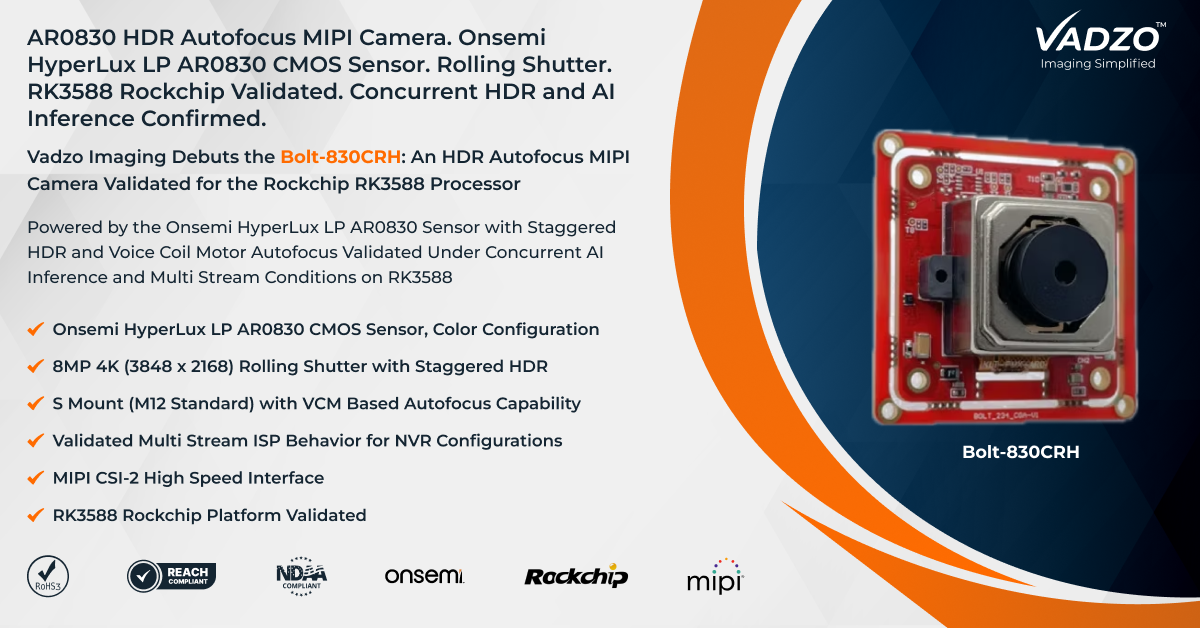
The Bolt-830CRH is an 8MP color rolling shutter MIPI camera built on the Onsemi HyperLux LP AR0830 sensor and validated specifically for the Rockchip RK3588 processor. OEMs choosing RK3588 over a lower-tier Rockchip platform are usually doing so because their application needs meaningfully more compute headroom, whether that means running a heavier AI inference model, aggregating several camera streams into a single NVR pipeline, or handling both HDR tone mapping and autofocus control without either process starving the other of ISP or NPU cycles. Vadzo confirms the AR0830’s staggered HDR pipeline and voice coil motor autofocus operate correctly on RK3588’s higher-performance ISP and NPU, including validated behavior under multi-stream configurations that a lower-tier platform could not sustain at the same resolution and frame rate. Output modes span full 4K capture down to 1080p and 720p. Designed for OEMs building edge AI vision systems, multi-camera NVR products, robotics, and industrial inspection platforms on Rockchip silicon, the Bolt-830CRH gives RK3588-based products the validated headroom their higher-performance platform choice was meant to provide.
FORT WORTH, TX / ACCESS Newswire / September 24, 2026 / Vadzo Imaging, a provider of embedded vision camera products for OEMs and system integrators, today announces validation of the Bolt-830CRH AR0830 HDR Autofocus MIPI Camera, an 8MP color rolling shutter camera built on the Onsemi HyperLux LP AR0830 sensor and confirmed for direct integration with the Rockchip RK3588 processor. Part of Vadzo’s MIPI camera portfolio, the Bolt-830CRH pairs the AR0830’s staggered HDR pixel architecture and voice coil motor autofocus with RK3588’s higher-performance ISP and neural processing unit, giving edge AI developers, NVR system integrators, and robotics OEMs a camera validated to run HDR processing, autofocus control, and AI inference together without one process starving another of compute resources. With this validation, Vadzo delivers an AR0830 HDR MIPI Camera that ships with confirmed device tree overlays, ISP tuning files, and Linux driver packages for RK3588, giving OEMs a camera module ready for direct integration into demanding edge AI and multi-camera products without independent platform validation work.
Technical Problem Definition
OEMs specifying RK3588 over a lower-tier Rockchip processor are almost always doing so because their application needs more compute headroom than a smaller platform can provide, whether that headroom goes toward a heavier AI inference model, a higher resolution capture pipeline, or a multi-camera configuration feeding several video streams into a single NVR product. A camera module validated only on a lower-tier Rockchip platform does not automatically confirm that the same HDR and autofocus behavior scales correctly once that camera is paired with RK3588’s higher-performance ISP and NPU, since a validation performed on a smaller platform says nothing about how the same sensor and lens assembly perform under RK3588’s specific media pipeline, multi-stream ISP configuration, or the concurrent processing load an OEM actually intends to run. This creates a specific risk for OEMs who selected RK3588 precisely because their application demands more than a lower tier platform can sustain. A camera that has only demonstrated basic capture on RK3588, without validating HDR tone mapping and autofocus control running alongside the AI inference workload or multi stream configuration the OEM actually plans to deploy, provides no real assurance that the camera will deliver its full performance once real world compute contention enters the picture. An OEM discovering this gap late in a product program, after a pilot deployment reveals that enabling full HDR processing degrades inference frame rate or that a second camera stream cannot be added without dropping resolution, faces exactly the kind of redesign the higher-performance platform was meant to avoid in the first place. A module marketed broadly as an RK3588 HDR MIPI Camera without RK3588 specific validation behind that label leaves this exact question unanswered, and an RK3588 HDR Autofocus Sensor that has only been characterized in isolation on an idle platform provides no real assurance about how it performs once an actual inference workload or multi stream configuration is running alongside it. Engineering teams that discover this gap after committing to a production bill of materials often face a costly platform revalidation cycle rather than the straightforward deployment a properly validated camera would have provided from the start.
Engineering Explanation
The Bolt-830CRH addresses this gap by validating the Onsemi HyperLux LP AR0830 sensor’s staggered HDR pixel architecture and voice coil motor autofocus lens specifically against Rockchip RK3588 hardware, rather than only confirming basic capture on the platform. The AR0830 is an 8MP color rolling shutter sensor with native 4K (3848 x 2168) resolution, built around a staggered pixel architecture that captures its full dynamic range within a single exposure interval rather than requiring several sequential frames merged after the fact. RK3588 provides meaningfully more ISP and NPU headroom than a lower-tier Rockchip processor, and Vadzo validates that this additional headroom is actually available to an OEM’s application by confirming HDR tone mapping, autofocus control, and AI inference operate concurrently without contention for shared compute resources. This makes the camera a genuine RK3588 Autofocus Vision Sensor platform, since autofocus response and focus accuracy are validated under the same concurrent processing load an OEM’s actual deployment will present, not only in isolation on an otherwise idle platform. Vadzo confirms the complete MIPI CSI-2 pad chain from the AR0830 sensor subdevice through RK3588’s CSI-2 receiver into the ISP pipeline, validating an RK3588 HDR Vision Module that OEMs can rely on rather than assembling HDR and autofocus configuration from a generic MIPI datasheet and RK3588’s own documentation independently. This qualifies the camera as an RK3588 HDR CSI-2 Sensor suited specifically to RK3588’s more demanding media pipeline, including confirmed behavior under multi-stream configurations where RK3588’s ISP aggregates several camera inputs simultaneously, a capability a lower-tier Rockchip platform cannot sustain at the same resolution and frame rate. The camera connects over MIPI CSI-2, providing sufficient bandwidth for full 4K capture as well as 1080p and 720p downsampled modes for higher frame rate operation. The camera is rated across a -30 degree C to +85 degree C operating range, matching the environmental conditions typical of NVR enclosures, robotics payload bays, and industrial inspection stations. Vadzo validates HDR and autofocus behavior specifically while a representative AI inference workload runs concurrently on RK3588’s NPU, since a validation performed on an otherwise idle platform says nothing about how the camera’s processing demands interact with the actual compute load an OEM’s finished product will run.
Product Overview
The Bolt-830CRH is an AR0830 HDR Autofocus MIPI Camera built on the Onsemi HyperLux LP AR0830 sensor and validated specifically for the Rockchip RK3588 processor. As an 8MP AR0830 Autofocus MIPI Camera, it is purpose-built for OEMs who need confirmed HDR and autofocus performance under the concurrent compute load an RK3588-based product actually presents, rather than a generic Rockchip compatibility claim that leaves the platform-specific validation question unanswered. The Onsemi AR0830 HDR MIPI Camera designation reflects Vadzo’s validation process, which confirms ISP tuning, autofocus response, and multi-stream behavior directly on RK3588 hardware before the module reaches OEM customers. The camera module houses the AR0830 sensor, ISP, autofocus lens assembly, and MIPI CSI-2 interface in a compact form factor with a standard M12 lens holder. As an AR0830 RK3588 Rockchip MIPI Camera, output modes include full 4K, 1080p, and 720p, selectable to balance resolution against frame rate and RK3588 ISP bandwidth for the target workload; the AR0830 8MP HDR Autofocus Camera designation specifically confirms this behavior under RK3588’s higher-performance media pipeline. As an 8MP RK3588 Rockchip MIPI Camera, the camera integrates with RK3588’s Linux camera stack through confirmed device tree overlays and ISP tuning files, requiring no independent calibration effort for HDR and autofocus capture. Available as an RK3588 Autofocus Sensor Kit for evaluation, the module gives engineering teams a validated reference for confirming both capabilities together on their own RK3588 hardware.
Key specs: 8MP 4K (3848 x 2168) | Onsemi HyperLux LP AR0830 1/2.9-inch 1.4-micron pixel | Color | Rolling Shutter with Staggered HDR | MIPI CSI-2 | RK3588 Rockchip Validated | S Mount (M12 Standard) with VCM Based Autofocus Capability | -30°C to +85°C
Key Capabilities of the Onsemi AR0830 4K Autofocus Camera Module
8MP HDR Resolution Validated for RK3588
Many camera modules paired with Rockchip silicon are validated only against a lower-tier reference platform, leaving OEMs specifying RK3588 specifically for its additional performance to discover configuration gaps once they deploy at full resolution and frame rate. The Bolt-830CRH, positioned as an 8MP RK3588 HDR Camera, is validated to deliver its full 8MP 4K HDR frame directly through RK3588’s ISP pipeline at practical frame rates for both still capture and real-time inference. This makes it a genuine 8MP RK3588 Autofocus Sensor that OEMs can specify with confidence when an application depends on RK3588’s additional headroom being available rather than consumed by unvalidated HDR and autofocus overhead.
RK3588 Rockchip Platform Validation for HDR and Autofocus
A camera module that lists RK3588 compatibility in its datasheet has not necessarily been validated against the specific ISP tuning, autofocus response, and multi-stream behavior RK3588’s more capable media pipeline actually supports. The Bolt-830CRH is validated specifically as an RK3588 8MP Vision Sensor, with Vadzo confirming ISP tuning file accuracy and autofocus control directly on RK3588 hardware under representative processing load before release. This makes the camera a confirmed reference design for OEMs building on RK3588 specifically for its additional compute headroom, rather than a generic MIPI sensor requiring independent platform integration work.
Concurrent HDR and AI Inference on RK3588’s Higher Performance NPU
A camera validated only with HDR processing running in isolation provides no assurance that the same HDR pipeline continues to perform once an OEM’s actual AI inference workload is also running on the same NPU. The Bolt-830CRH’s HDR and autofocus behavior is validated specifically under concurrent AI inference load, confirming that RK3588’s additional NPU headroom over a lower-tier Rockchip platform is genuinely available to an OEM’s application rather than consumed by unvalidated interaction between the camera’s processing demands and the inference workload sharing the same silicon. This matters directly for OEMs who selected RK3588 specifically to run a heavier detection or recognition model than a smaller platform could support, since an RK3588 HDR Vision System that has not been validated under this exact condition leaves the actual performance headroom an open question until deployment. Engineering teams evaluating this camera can confirm inference frame rate holds steady with HDR capture active, rather than discovering a performance penalty only after their application is already running in production.
Multi Stream ISP for NVR and Multi Camera Configurations
Multi-camera NVR products depend on a host platform’s ISP aggregating several video streams simultaneously without degrading per-stream resolution or frame rate, a capability that differentiates RK3588 from lower-tier Rockchip processors limited to a single camera input at full performance. The Bolt-830CRH is validated specifically under RK3588’s multi-stream ISP configuration, confirming that HDR tone mapping and autofocus control continue to perform correctly when the camera’s stream is one of several being aggregated simultaneously, functioning as an AR0830 RK3588 Embedded Vision suited to NVR products and multi-camera robotics platforms that a single-stream validation would not adequately confirm.
Multi-Resolution Output for Edge AI Workflows
Selectable output resolution lets a single Bolt-830CRH serve multiple roles within the same RK3588-based product. Full 4K mode captures maximum spatial detail for archival recording or fine inspection tasks. The 1080p mode balances resolution and ISP bandwidth for continuous multi-stream NVR configurations, while 720p mode supports higher frame rate operation for real-time inference tasks. Because every output mode is derived from the same staggered HDR sensor readout, switching resolution modes introduces no exposure shift, which matters for automated systems that expect consistent HDR behavior regardless of which output mode the current pipeline stage or camera stream requires.
OEM Integration for RK3588 Programs
The Bolt-830CRH ships with confirmed device tree overlays, ISP tuning files, and Linux driver packages for RK3588, giving OEMs a validated starting point rather than an open-ended integration project. Available as an RK3588 HDR Camera Kit for evaluation, the camera lets engineering teams confirm HDR and autofocus behavior under their own concurrent processing load on RK3588 hardware before committing to a production order. For OEMs evaluating Vadzo as an OEM RK3588 HDR Module supplier, this means lens matching, firmware customization, and enclosure design support are available alongside the core camera hardware rather than as a separate engagement. As a MIPI HDR Camera for RK3588, the Bolt-830CRH is validated for straightforward integration across RK3588-based development boards and production carrier boards alike. Vadzo’s track record as an RK3588 HDR Camera Manufacturer covers production programs spanning multiple sensor families and interface types for OEM customers building demanding edge AI and multi-camera products on Rockchip silicon.
“OEMs who choose RK3588 over a smaller Rockchip platform are telling us something specific: their application needs more headroom, whether that is a heavier inference model, more camera streams, or both. What we kept hearing was that a camera validated only on a lower-tier platform, or validated on RK3588 with nothing else running, does not actually confirm that headroom is available once the real application workload is in place. The Bolt-830CRH was built to answer that question directly. By validating the Onsemi AR0830’s HDR and autofocus performance on RK3588 under concurrent inference and multi-stream conditions, we give OEMs a camera where the performance headroom they paid for in a higher-tier processor is confirmed, not assumed.” – Alwin Vincent, Product Manager, Vadzo Imaging.
Application Specific Sections
Edge AI Development on RK3588
Engineering teams building a new edge AI vision product on RK3588 often start from a development board before committing to a custom carrier design, and the camera they prototype with needs to demonstrate HDR and autofocus performance under the same concurrent inference load the production system will actually run. The Bolt-830CRH works as an RK3588 HDR Edge AI Camera for exactly this evaluation stage, connecting directly to standard RK3588 development board camera connectors with confirmed driver and ISP tuning support, so engineering teams can validate performance headroom before finalizing a production design.
Robotics and Machine Vision on RK3588
Robotics platforms running RK3588 for its additional compute headroom depend on HDR image quality and autofocus accuracy holding steady while navigation, object detection, and manipulation algorithms run concurrently on the same processor. The Bolt-830CRH functions as an RK3588 HDR Robotics Camera for these deployments, giving robotics integrators confirmed camera performance under the exact concurrent processing conditions their application actually presents, and its suitability as an AR0830 RK3588 Machine Vision platform extends to machine vision tasks depending on the same concurrent HDR and inference validation.
Multi Camera NVR and Security Recording
Multi-camera NVR products depend on RK3588’s ability to aggregate several video streams simultaneously without degrading per-stream image quality, a capability that specifically justifies choosing RK3588 over a single-stream lower-tier platform. The Bolt-830CRH serves as an RK3588 HDR NVR Camera for these systems, with validated multi-stream HDR and autofocus behavior confirming that each camera in a multi-unit NVR deployment delivers consistent performance rather than degrading as additional streams are added to the same RK3588 host. Security integrators building an NVR product around several of these camera units can specify the same validated module across every camera position, rather than qualifying a separate camera variant for single-stream and multi stream deployment scenarios.
Kiosk and Self Service Systems
Self-service kiosks running heavier AI workloads for interaction detection or identity verification often select RK3588 specifically for the additional NPU headroom that workload requires. The Bolt-830CRH functions as an RK3588 HDR Kiosk Camera for these deployments, giving kiosk OEMs confirmed HDR performance for variable lighting conditions and autofocus accuracy for users presenting items at different distances, validated under the same concurrent AI inference load the kiosk’s interaction detection model actually runs.
Industrial Inspection on RK3588
Industrial inspection stations processing video directly on an embedded module rather than a central server depend on the ISP and NPU pipeline between the sensor and the inspection algorithm being correctly tuned and genuinely available under real processing load. The Bolt-830CRH functions as an RK3588 HDR Industrial Camera for these systems, with confirmed ISP tuning and validated concurrent inference performance reducing the integration timeline for OEMs deploying edge AI inspection on RK3588 across multiple production lines, and its suitability as an RK3588 HDR Drone Camera extends to inspection payloads mounted on mobile platforms requiring the same validated concurrent performance.
Frequently Asked Questions
Q: Why does Vadzo Imaging validate this camera specifically on the RK3588 processor rather than a lower-tier Rockchip chip?
A: Vadzo Imaging designs this camera around the reason OEMs actually choose RK3588 over a smaller Rockchip processor, which is the need for more compute headroom for a heavier AI model, more camera streams, or both. Vadzo Imaging validates HDR tone mapping, autofocus control, and AI inference running concurrently on RK3588 hardware specifically so that the additional headroom an OEM paid for in a higher-tier processor is genuinely confirmed rather than assumed from a basic capture test. Vadzo Imaging considers a validation that stops at basic capture an incomplete answer to the question an RK3588 OEM is actually asking.
Q: Can this camera run HDR processing and AI inference at the same time without one slowing down the other?
A: Yes. Vadzo Imaging validates the camera’s HDR pipeline and autofocus control specifically while an AI inference workload runs concurrently on the RK3588’s NPU, confirming that both processes operate correctly together rather than testing each capability in isolation on an otherwise idle platform. Vadzo Imaging considers this concurrent validation essential, since most real RK3588 deployments run HDR capture and AI inference together, not one at a time.
Q: Does this camera support multi-camera or NVR configurations on RK3588?
A: Yes. Vadzo Imaging validates this camera’s HDR and autofocus behavior specifically under RK3588’s multi-stream ISP configuration, confirming that image quality holds steady when the camera’s stream is one of several being aggregated simultaneously into an NVR or multi-camera product. Vadzo Imaging prioritizes this validation because RK3588’s multi-stream capability is a primary reason OEMs select it over a single-stream, lower-tier platform.
Q: Is integration different for OEMs moving from a lower performance Rockchip platform to RK3588?
A: Vadzo Imaging designs the device tree overlays, ISP tuning files, and driver packages for this camera specifically around RK3588’s media pipeline, which differs from a lower-tier Rockchip platform’s simpler single-stream ISP configuration. Vadzo Imaging supplies RK3588-specific validation and documentation directly, so OEMs migrating a product from a smaller Rockchip platform receive a camera already confirmed for RK3588 rather than needing to revalidate HDR and autofocus behavior independently on the new platform. This distinction matters for OEMs planning a platform upgrade partway through a product’s lifecycle, since a camera validated only on the original lower-tier platform offers no guarantee that the same configuration transfers cleanly to RK3588’s different media pipeline.
Q: Why should OEMs building RK3588 vision products choose Vadzo Imaging as their camera supplier?
A: Vadzo Imaging offers more than a camera that lists RK3588 compatibility on a spec sheet. OEMs building RK3588 vision products and working with Vadzo Imaging receive a camera validated under the concurrent processing conditions their actual application will run, along with engineering support covering lens selection, firmware customization, and ISP tuning guidance. Vadzo Imaging maintains evaluation kits with no minimum order requirement, so engineering teams can confirm performance headroom on their own RK3588 hardware before committing to volume production. This combination of validated concurrent performance and low minimum evaluation access is why RK3588 OEMs continue to choose Vadzo Imaging for demanding edge AI and multi-camera programs.
Availability
The Bolt-830CRH AR0830 HDR Autofocus MIPI Camera built on the Onsemi HyperLux LP AR0830 sensor is available now for evaluation and production orders. Evaluation kits include the camera module, autofocus lens assembly, MIPI CSI-2 flex cable, and RK3588 device tree, ISP tuning, and driver documentation, with no minimum order requirement. Engineering teams can confirm HDR and autofocus performance under their own concurrent processing load directly on RK3588 hardware before committing to a production bill of materials, which matters more for this camera than a datasheet comparison alone could confirm. Browse the full range of RK3588 camera options at Vadzo’s website or contact Vadzo at support@vadzoimaging.com to request an evaluation unit or discuss OEM integration requirements for edge AI, NVR, robotics, and industrial inspection camera programs on Rockchip silicon.
About Vadzo Imaging
Vadzo Imaging is a global provider of embedded vision solutions and delivers high-performance camera technologies and imaging platforms for applications in robotics, industrial automation, UAVs, edge AI, and medical systems. Its products are designed for seamless integration with leading embedded platforms including NVIDIA Jetson, Raspberry Pi, Rockchip, and NXP i.MX. Vadzo supports customers through hardware customization, firmware development, and module-level drivers, enabling faster development and deployment of vision-based systems across MIPI, USB, GigE, Wi-Fi, and SerDes camera interfaces.
Media Contact
Alwin Vincent
Vadzo Imaging
Email: alwin@vadzoimaging.com
LinkedIn: Vadzo Imaging
YouTube: Vadzo Imaging
X: Vadzo Imaging
SOURCE: Vadzo Imaging
View the original press release on ACCESS Newswire
Media gallery

