Bioenergy Market Projected to Reach USD 241.9 Billion by 2035, Growing at 5.0% CAGR
Bioenergy Market is projected to reach USD 155.9 billion in 2026 before climbing to USD 241.9 billion by 2035,
Press Release Disclaimer: This is a press release distributed through the XPR Media network. It has not been independently verified by our newsroom.
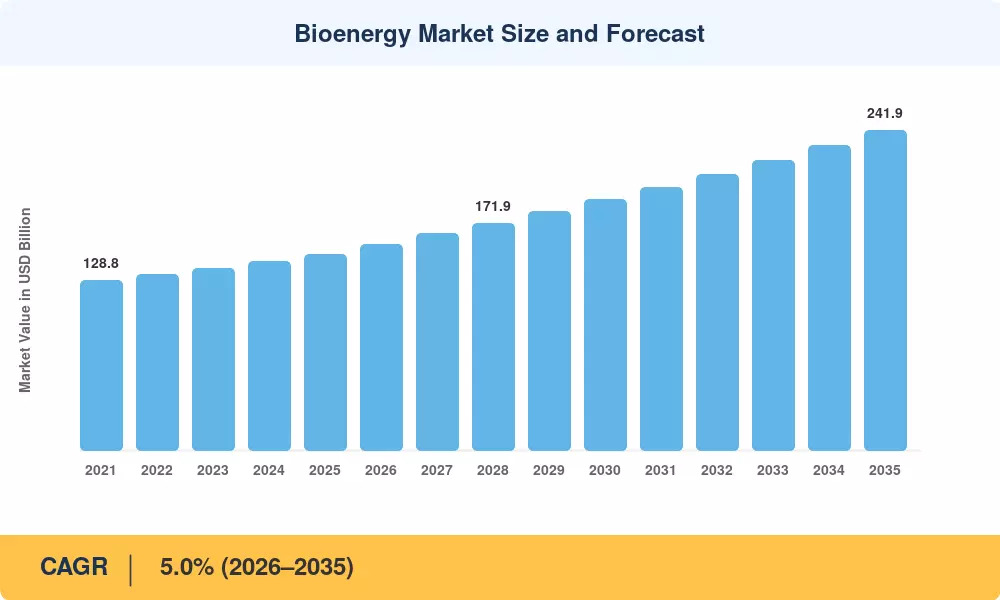

Bioenergy Market is projected to reach USD 155.9 billion in 2026 before climbing to USD 241.9 billion by 2035, reflecting a 5.0% CAGR
NEW YORK, NY, UNITED STATES, August 24, 2026 /EINPresswire.com/ — As Per the MRFR Analysis, Bioenergy Market is projected to reach USD 155.9 billion in 2026 before climbing to USD 241.9 billion by 2035, reflecting a 5.0% CAGR across the forecast 2026 to 2035, driven by Advancements in waste-to-energy technologies.
Market Overview
The Bioenergy Market encompasses energy derived from organic materials—including solid biomass, biogas, renewable waste, and liquid biofuels—used for power generation, heating, and transportation. This renewable energy source plays a critical role in the global energy transition by providing dispatchable, firm, and carbon-neutral power that complements intermittent renewables like solar and wind.
Several growth drivers are fueling the expansion of the Bioenergy Market. Net-zero pledges signed by over 140 nations and the EU’s revised Renewable Energy Directive—targeting a 42.5% renewable share by 2030—are channeling capital into bio-based generation [1]. The sector benefits from a dual policy tailwind: governments want firm, carbon-neutral power that can complement intermittent renewables, and bioenergy delivers exactly that. Carbon pricing mechanisms, with EU ETS prices surpassing EUR 90 per tonne in early 2024, make biomass co-firing economically competitive with unabated natural gas [1].
A significant technology shift is reshaping how organic feedstocks are converted into usable energy. Legacy open-grate combustion boilers are giving way to advanced fluidized-bed systems, high-efficiency gasifiers, and modular anaerobic digesters that cut levelized costs by 18–22% relative to 2018 baselines [2]. The IEA’s 2024 World Energy Outlook pegged cumulative bioenergy investment needs at USD 135 billion through 2030, signaling strong institutional backing for next-generation conversion platforms. Advances in waste-to-energy technologies, including gasification and anaerobic digestion, are enabling more efficient conversion of municipal solid waste and agricultural residues into valuable energy products.
Policy and regulatory influence continues to shape demand patterns. The U.S. EPA finalized 2025 Renewable Volume Obligations at 22.33 billion gallons, an 8% increase over 2023 levels [7]. Brazil’s RenovaBio program similarly raised its decarbonization credit targets by 12% for 2025, guaranteeing demand for ethanol and biodiesel producers. The European Commission’s RED III sustainability criteria require comprehensive chain of custody documentation and greenhouse-gas savings exceeding 80% for new installations [16].
The demand outlook for the Bioenergy Market remains highly positive. Asia-Pacific commands roughly 40.0% of the market, driven by China’s 14th Five-Year Plan biomass targets and India’s SATAT compressed biogas initiative [3]. Europe holds the second-largest share at 28.5%, buoyed by stringent carbon pricing under the EU ETS. North America contributes 18.0%, with the U.S. Inflation Reduction Act extending production tax credits. As feedstock logistics improve and carbon credit regimes mature, the Bioenergy Market is set to solidify its role as the backbone of dispatchable renewable capacity worldwide.
📍 Get Free Sample Report for Detailed Market Insights:
https://www.marketresearchfuture.com/sample_request/11632
Market Segmentation
By Type
The Bioenergy Market is segmented into Solid Biomass, Biogas, Renewable Waste, and Other Types (liquid biofuels and emerging algal pathways). Solid biomass accounted for 62.0% of the market in 2025, underpinned by established pellet supply chains and co-firing retrofits across coal-dependent grids [5]. International pellet trade reached approximately 26 million tonnes in 2024, with major flows from the U.S. Southeast and Canada to Europe and East Asia. Biogas is the fastest-expanding type segment, projected to register a 10.9% CAGR through 2035 as municipal waste diversion mandates intensify [6]. Renewable waste represents a growing segment at USD 18.2 billion in 2025, driven by municipal solid waste landfill bans and advancements in waste-to-energy conversion technologies.
By Technology
The market serves Combustion, Gasification, Anaerobic Digestion, and Other Technologies (pyrolysis, torrefaction, hydrothermal processing). Combustion technology retained 78.5% of installed capacity in 2025, leveraging decades of operational know-how and deep integration with existing power infrastructure [2]. Anaerobic digestion is forecast to grow at a 12.7% CAGR to 2035, reflecting rapid deployment of modular biogas units and food-waste diversion programs [6]. Gasification is expanding at a 4.7% CAGR, driven by syngas-to-chemicals pathways and integrated biorefinery concepts [10].
By Application
The Bioenergy Market serves Heat Generation, Electricity Generation, and Transportation Fuel applications. Heat Generation holds the largest share at 53.5% of the market, because thermal applications require minimal conversion complexity—simple biomass boilers deliver heat at efficiencies above 85% [11]. Electricity Generation accounts for USD 42.8 billion, supported by feed-in tariffs and renewable portfolio standards [12]. Transportation Fuel represents the fastest-growing segment at a 10.15% CAGR, as aviation decarbonization mandates create a new high-value demand channel for bio-based jet fuel under the EU’s ReFuelEU Aviation mandate requiring SAF blends of 6% by 2030 [12].
By End-User
The Bioenergy Market serves Power Utilities, Commercial and Industrial, and Residential end-users. Power utilities anchor the market at 40.7% share because grid-scale biomass plants provide the dispatchable generation that system operators need to balance variable wind and solar output [6]. The commercial and industrial segment is gaining momentum at a 9.5% CAGR as manufacturers seek biomass-based process steam and certified renewable gas to satisfy tightening ESG disclosure requirements [13]. Residential applications account for USD 14.8 billion, driven by pellet stove adoption in rural heating markets and distributed biogas systems in developing regions.
🛒 You can buy this market report at:
https://www.marketresearchfuture.com/checkout?currency=one_user-USD&report_id=11632
Regional Analysis
North America
North America holds 18.0% of the Bioenergy Market, driven by the U.S. Inflation Reduction Act extending production tax credits and renewable fuel standard mandates. The United States remains the region’s anchor with over 16 GW of installed biomass capacity and a robust Renewable Fuel Standard that guarantees biofuel off-take [7]. Canada’s Clean Fuel Regulations, effective since July 2023, create lifecycle carbon-intensity benchmarks that favor advanced biofuel production [22]. Mexico’s market draws strength from abundant agave and sugarcane residues, though regulatory uncertainty around energy reform tempers investment velocity [23]. The region is projected to grow at a 4.8% CAGR through 2035, supported by co-firing retrofits and IRA incentives for biopower [8].
Europe
Europe holds the second-largest share of the Bioenergy Market at 28.5%, buoyed by stringent carbon pricing under the EU ETS and well-established district heating infrastructure. Germany operates the largest biogas fleet globally—over 9,500 plants—supported by EEG feed-in tariffs [11]. The UK’s Drax power station is transitioning into the world’s first large-scale BECCS facility, targeting 8 million tonnes of annual CO₂ removal by 2030 [18]. France’s PPE national energy plan targets 38 TWh biomass heat by 2028 [24]. The Nordic countries leverage extensive district heating networks and forestry residue availability, while Russia’s market focuses on wood-waste utilization in Siberian forestry regions [25]. Europe’s Bioenergy Market benefits from the world’s most mature carbon pricing mechanism and RED III compliance requirements [1].
Asia-Pacific
Asia-Pacific commands the largest share of the Bioenergy Market at 40.0%, driven by China’s 14th Five-Year Plan biomass targets and India’s SATAT compressed biogas initiative [3]. China’s biomass power installed capacity surpassed 40 GW in 2024, driven by provincial feed-in tariffs and rural waste management objectives [3]. India targets 10,000 compressed biogas plants under the SATAT initiative, with 1,200 operational by end-2025, supported by the National Bioenergy Programme Phase II allocating INR 858 crore to support 300 new compressed biogas plants between 2024 and 2028 [10]. Japan’s generous FIT rates for biomass—approximately JPY 24/kWh for small-scale plants—have attracted significant foreign pellet imports, making the country the third-largest biomass power generator in the region [26]. Southeast Asian nations leverage palm oil residue cogeneration and rice husk power, while South Korea implements a Renewable Portfolio Standard with biomass co-firing credits [26][27].
Rest of the World
South America, Middle East & Africa, and other regions represent approximately 13.5% of the Bioenergy Market. Brazil dominates South American demand, with its sugarcane-ethanol complex recognized as the world’s most efficient biofuel system, with mill-gate costs below USD 0.35 per liter. The RenovaBio programme issued over 35 million decarbonization credits (CBIOs) in 2024, providing financial incentive for capacity expansion [28]. Argentina maintains a B10 biodiesel blending mandate and exports roughly 1.5 million tonnes of biodiesel annually [29]. The Middle East & Africa region records among the highest growth rates, propelled by waste-management crises and development finance. Saudi Arabia’s National Waste Management Centre has tendered three large-scale refuse-derived fuel facilities, while South Africa’s Integrated Resource Plan allocates 803 MW to biomass and biogas through 2030 [30].
Competitive Landscape / Key Players
The Bioenergy Market exhibits medium concentration, with the top five players commanding an estimated 28–35% of global revenue. Key players include Drax Group, Enviva Partners, Ørsted, Vattenfall, E.ON, Veolia Environnement, Babcock & Wilcox, Mitsubishi Heavy Industries, Ameresco, and Xcel Energy [14].
Drax Group leads with an estimated 7–10% revenue share, operating the largest single-site biomass generator and pioneering BECCS development in the UK [18]. Enviva Partners follows with 5–8% share as the world’s largest industrial wood pellet producer, with long-term off-take contracts securing its market position [5]. Ørsted holds 4–6% share, transitioning coal assets to sustainable biomass while integrating offshore-onshore renewable capacity [6]. Vattenfall commands 3–5% share, leading Nordic district heating with forestry residue supply. E.ON maintains 3–5% share as a European energy retail leader with an integrated biogas portfolio [11]. Veolia Environnement holds 3–5% share, leveraging global waste management with energy recovery capabilities [14].
Strategic developments in the industry include the European Commission’s June 2024 publication of delegated acts under RED III clarifying sustainability criteria for forest biomass, affecting feedstock certification across the Bioenergy Market [16]. The U.S. EPA finalized 2024–2025 Renewable Volume Obligations under the RFS at 22.33 billion gallons in July 2023, securing demand for biofuel producers [7]. The UK’s Contracts for Difference framework allocated GBP 227 million to biomass projects in Allocation Round 6 [9].
Latest Industry News & Developments
European Commission (June 2024): Published delegated acts under RED III clarifying sustainability criteria for forest biomass, affecting feedstock certification across the Bioenergy Market [16].
U.S. EPA (July 2023): Finalized 2024–2025 Renewable Volume Obligations under the RFS at 22.33 billion gallons, securing demand for biofuel producers [7].
UK Government (September 2024): Confirmed GBP 227 million in Contracts for Difference funding for biomass projects in Allocation Round 6, directly channeling capital into the Bioenergy Market [9].
India’s Ministry of New and Renewable Energy (March 2024): Announced Phase II of the National Bioenergy Programme with INR 858 crore allocated to support 300 new compressed biogas plants between 2024 and 2028 [10].
Market Challenges & Opportunities
Challenges
The Bioenergy Market faces several notable challenges. Feedstock price volatility and logistics represent a significant restraint, with wood pellet spot prices on the Baltic CIF index ranging from USD 145 to USD 310 per tonne throughout 2022-2024, with operators without long-term supply contracts facing margin squeeze [15]. Transport costs can be 35-50% of the delivered feedstock price in landlocked regions, shaking investor trust in ventures not vertically integrated into supply chains.
Sustainability certification complexity poses another constraint, with the EU RED III criteria requiring comprehensive chain of custody documentation and greenhouse-gas savings exceeding 80% for new installations [16]. Audit expenses can exceed USD 150,000 per site for small and mid-sized companies in Southeast Asia and South America, creating administrative complexity that hinders market entry. Public opposition and permitting delays in Europe and North America, competition from declining solar/wind costs, and the capital intensity of advanced conversion technologies further challenge market growth.
Opportunities
Significant opportunities exist in the Bioenergy Market. Negative-emission revenue via BECCS deployment represents a rare opportunity for net negative emissions, with the U.S. 45Q tax credit now offering $85 per tonne for geologic sequestration [18]. Early movers can generate dual revenue from power sales and carbon reduction credits by co-locating capture infrastructure with existing biomass plants.
Sustainable aviation fuel scale-up presents a transformative opportunity, with ICAO’s CORSIA framework and EU’s ReFuelEU Aviation mandating SAF blends of 6% by 2030, up to 70% by 2050 [12]. BloombergNEF estimates that investment in SAF could reach USD 40 billion per year by 2032. Emerging-market distributed biogas offers a fast-growth pocket, with multilateral development banks committing USD 2.8 billion in bioenergy financing for low-income countries in 2024 [19].
Digital feedstock platforms and data monetization represent a new business model layer, with startups building marketplace platforms that aggregate residue supply data and optimize logistics with AI-driven routing, reducing procurement costs by 12–18% [20]. Industrial heat decarbonization opens a high-value application corridor, as EU industrial emitters facing carbon costs above EUR 70 per tonne increasingly contract biomass heat to substitute coal in kiln and furnace applications at temperatures above 1,000 °C [21].
To explore more market insights, visit us at:
https://www.marketresearchfuture.com/reports/bioenergy-market-11632
Final Market Summary
The Bioenergy Market is poised for robust growth, projected to reach USD 155.9 billion in 2026 and USD 241.9 billion by 2035, at a CAGR of 5.0%. This expansion is fundamentally underpinned by advancements in waste-to-energy technologies, net-zero legislation, carbon pricing mechanisms, and renewable fuel standard mandates that secure baseline off-take volumes for bioenergy producers. Asia-Pacific maintains its dominant position, while Europe and North America follow with significant investments in biomass co-firing, biogas deployment, and sustainable aviation fuel development. Technological innovation, including advanced gasification, modular anaerobic digestion, and digital feedstock platforms, is reshaping the competitive landscape, enabling operators to achieve lower levelized costs and improved operational efficiency. The market’s long-term potential remains exceptionally strong, supported by the convergence of decarbonization policy, corporate ESG commitments, and emerging opportunities in BECCS deployment and industrial heat decarbonization, ensuring bioenergy’s critical role as firm, dispatchable renewable capacity in the global energy mix through 2035 and beyond.
More Related Reports from MRFR Library:
India Electric Motors Market: https://www.marketresearchfuture.com/reports/india-electric-motors-market-48664
Mexico Biogas Market: https://www.marketresearchfuture.com/reports/mexico-biogas-market-55249
Europe Ancillary Services Power Market: https://www.marketresearchfuture.com/reports/europe-ancillary-services-power-market-55257
UK Hydrogen Mobility Market: https://www.marketresearchfuture.com/reports/uk-hydrogen-mobility-market-65797
Substation Batteries Market: https://www.marketresearchfuture.com/reports/substation-batteries-market-933
Next Generation Batteries Market: https://www.marketresearchfuture.com/reports/next-generation-batteries-market-1142
USA HVAC Motors Market: https://www.marketresearchfuture.com/reports/usa-hvac-motors-market-1187
Submersible Pumps Market: https://www.marketresearchfuture.com/reports/submersible-pumps-market-1351
Directional Drilling Market: https://www.marketresearchfuture.com/reports/directional-drilling-market-1375
Renewable Energy Market: https://www.marketresearchfuture.com/reports/renewable-energy-market-1515
Larry Wilson
WantStats Research And Media Pvt. Ltd.
+ +1 855-661-4441
email us here
Visit us on social media:
LinkedIn
Facebook
YouTube
X
Legal Disclaimer:
EIN Presswire provides this news content “as is” without warranty of any kind. We do not accept any responsibility or liability
for the accuracy, content, images, videos, licenses, completeness, legality, or reliability of the information contained in this
article. If you have any complaints or copyright issues related to this article, kindly contact the author above.

Media gallery