
Nabla Integrates with OpenEvidence to Deliver Clinical Evidence at the Point of Care
NEW YORK, Oct. 15, 2026
Press Release Disclaimer: This is a press release distributed through the XPR Media network. It has not been independently verified by our newsroom.
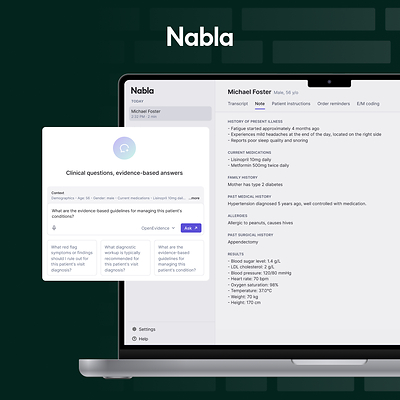

Nabla Integrates with OpenEvidence to Deliver Clinical Evidence at the Point of Care
PR Newswire
NEW YORK, Oct. 15, 2026
New integration brings clinical decision support into the encounter workflow, connecting patient context with evidence-based guidance to help clinicians make informed decisions
NEW YORK, Oct. 15, 2026 /PRNewswire/ — Nabla, one of the most widely adopted AI assistants in clinical care, today announced an integration with OpenEvidence, the leading AI-powered clinical decision support platform, making trusted medical evidence accessible within Nabla.
Clinical documentation and clinical decision support (CDS) are deeply connected, yet the tools supporting them are often disconnected. Clinicians may document in one application, then switch to another and re-enter relevant patient information to find clinical guidance. Nabla’s integration with OpenEvidence is designed to remove that friction by connecting those steps, bringing documentation and decision support into a more seamless workflow.
From within Nabla, clinicians can now open “Clinical questions” alongside their note and ask questions specific to the patient they are treating. Nabla automatically provides relevant patient context to OpenEvidence, including patient demographics, visit diagnosis, current medications, provider-drafted context and the Nabla-generated note. Clinicians can then access sourced, cited answers grounded in peer-reviewed medical literature to help inform their decisions and care plans. Patient privacy remains protected throughout the workflow, with all context anonymized in line with security standards and no protected health information (PHI) involved.
“Clinicians shouldn’t have to choose between spending time with their patients and searching for the information they need,” said Laurent Landowski, Chief Product Officer at Nabla. “Because Nabla already captures the context of the encounter, we’ve made it easier for clinicians to access trusted evidence that is relevant to the patient in front of them. And rather than asking health systems to adopt another closed platform, we want to give them the flexibility to use the clinical knowledge tools they already trust.”
The OpenEvidence integration is part of Nabla’s broader evolution from clinical documentation to a more intelligent clinical workflow, where the context captured during an encounter can support clinicians throughout the patient lifecycle. OpenEvidence is trusted by millions of verified U.S. healthcare professionals, demonstrating how deeply the platform has become embedded in clinicians’ day-to-day work. As Nabla expands across the care journey, flexibility remains core to its approach, bringing the tools health systems already rely on into the Nabla experience so clinicians can access them seamlessly within their existing workflows.
“What once took hours of research now takes minutes,” said Selwyn-Lloyd Mc Pherson, MD, a comprehensive neurologist, clinical neurophysiologist and epileptologist. “Having relevant evidence at my fingertips, grounded in the context of each patient, helps me make more informed decisions with confidence, and provides patients with an up-to-date, evidence-based plan for their care.”
Looking ahead, Nabla sees an opportunity to make clinical decision support more proactive, moving from a model where clinicians seek out information to one where relevant guidance can be surfaced at the right moment.
To learn more about Nabla, visit: nabla.com
About Nabla
Nabla is a clinical AI company building Contextual Clinical Intelligence for modern healthcare organizations. Embedded directly into clinical workflows, Nabla helps health systems reduce administrative burden, improve documentation quality, and streamline care delivery through AI-powered documentation, coding support, and workflow automation. Nabla integrates with all major EHRs, supports more than 35 languages, and is trusted by over 125,000 clinicians across 190 health systems and provider groups. Built in close collaboration with clinicians and health systems, Nabla’s clinical AI assistant supports care teams before, during, and after the patient encounter, enabling organizations to move beyond fragmented AI tools to an intelligent, connected approach to healthcare delivery. Bold in technology and responsible by design, Nabla enables health systems to shape their own AI future. Learn more at www.nabla.com
CONTACT: nabla@inkhouse.com

 View original content to download multimedia:https://www.prnewswire.com/news-releases/nabla-integrates-with-openevidence-to-deliver-clinical-evidence-at-the-point-of-care-302909243.html
SOURCE Nabla

